
Instagram: @covetherapies
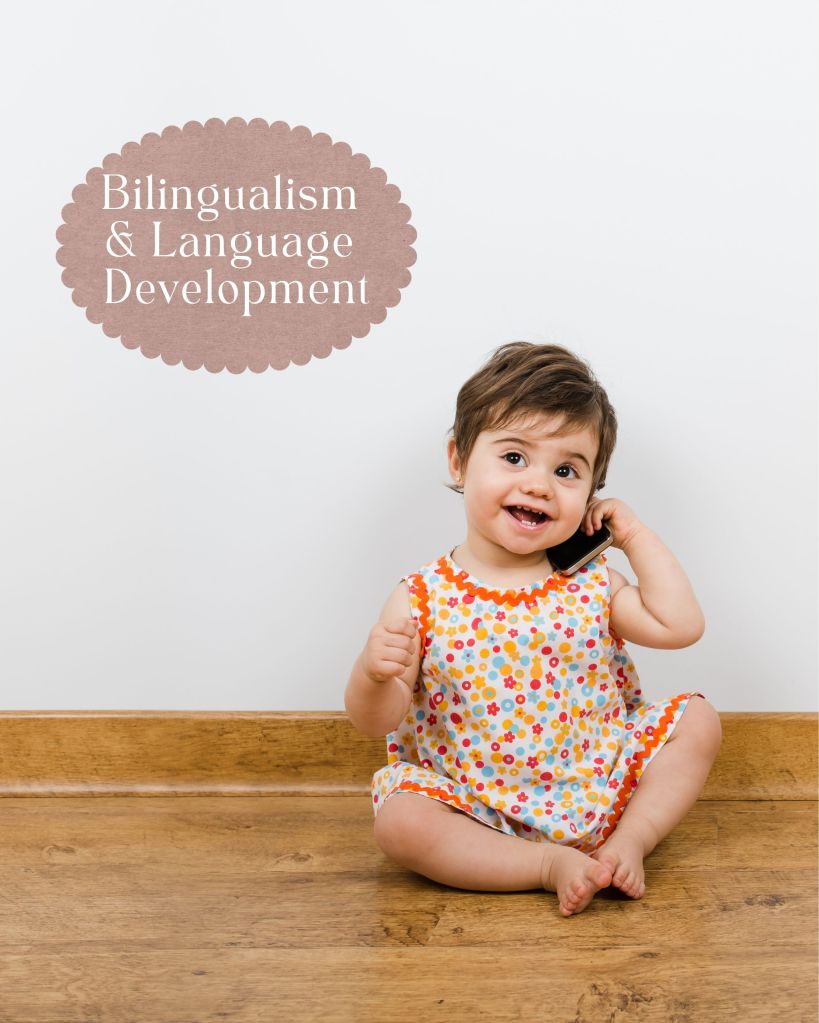
Bilingualism Myth-Buster ⭐
This is a question speech therapists receive often, so let’s discuss!
💡Did you know… studies find that learning more than one language does not cause delays in language development.
Bilingual children may mix languages as they learn, but this is a normal and healthy part of development. 🌱
Using more than one language can allow children to build and maintain meaningful ties to their culture, family, and community. It may also strengthen overall communication and early academic skills.
Tips for families:
🐣 Start early. Use your languages with your child as early as you can; the more input the better.
💛 Keep speaking the language you’re most comfortable speaking in. Quality and quantity are important.
📚 Read and sing in both languages (separately) when you can.
🔁 Use daily routines for natural language practice.
Note: If you’re noticing speech or language delays, these delays are likely to show up across languages. In this case, it’s best to chat with an SLP!
You Might Be Asking Your Toddler Too Many Questions! 👀 My number one tip to parents of late talkers or early communicators.
And you’re not alone…we all do it!
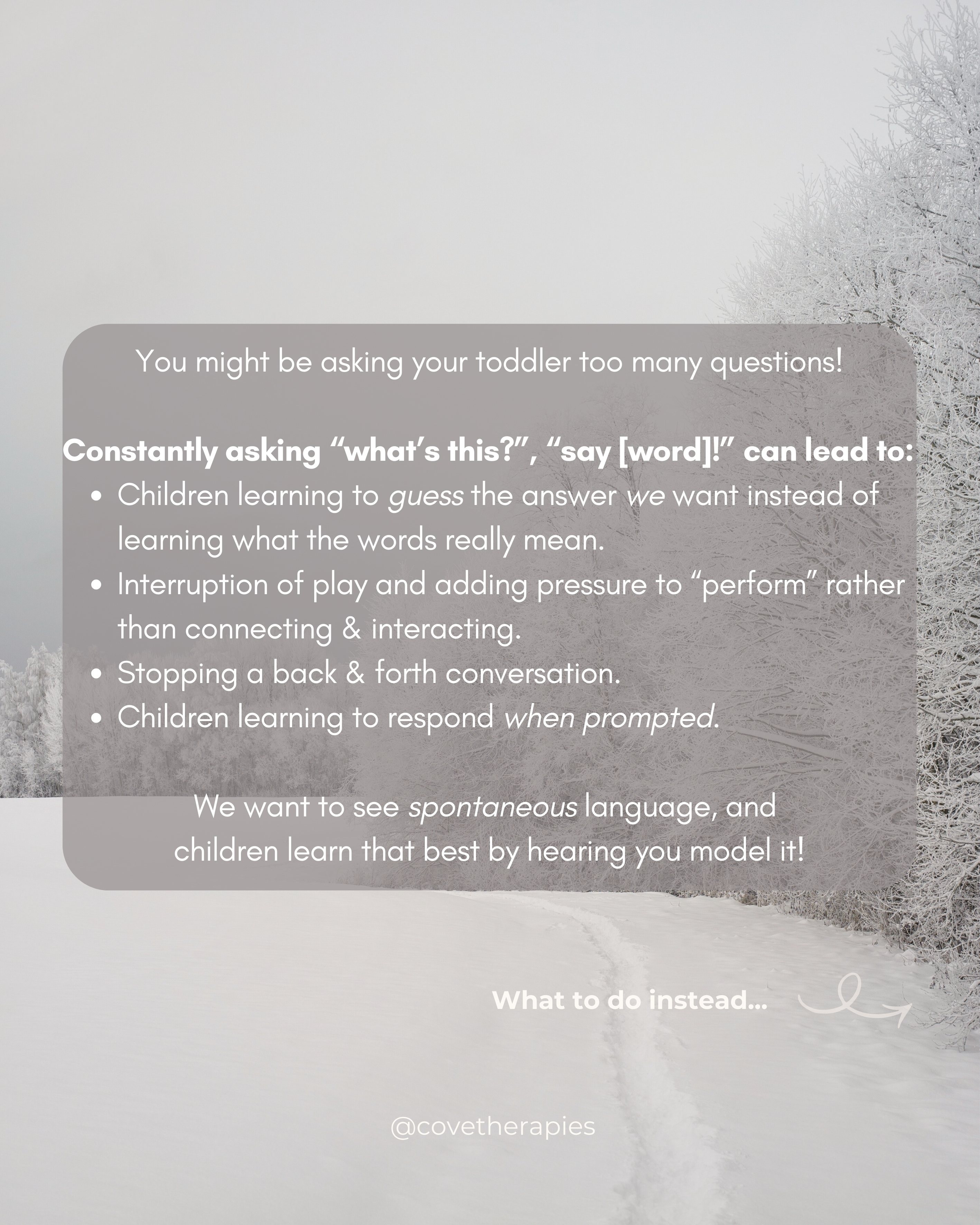
Questions like “What’s this?” or “Say ___!” are usually meant to help, but here’s a gentle shift that can make a big difference.
Frequent quizzing during play can lead to:
– Children waiting to be prompted to communicate.
– Guessing the answer instead of learning what words really mean.
– Interruption of play, adding pressure to “perform,” rather than connection and back-and-forth interaction.
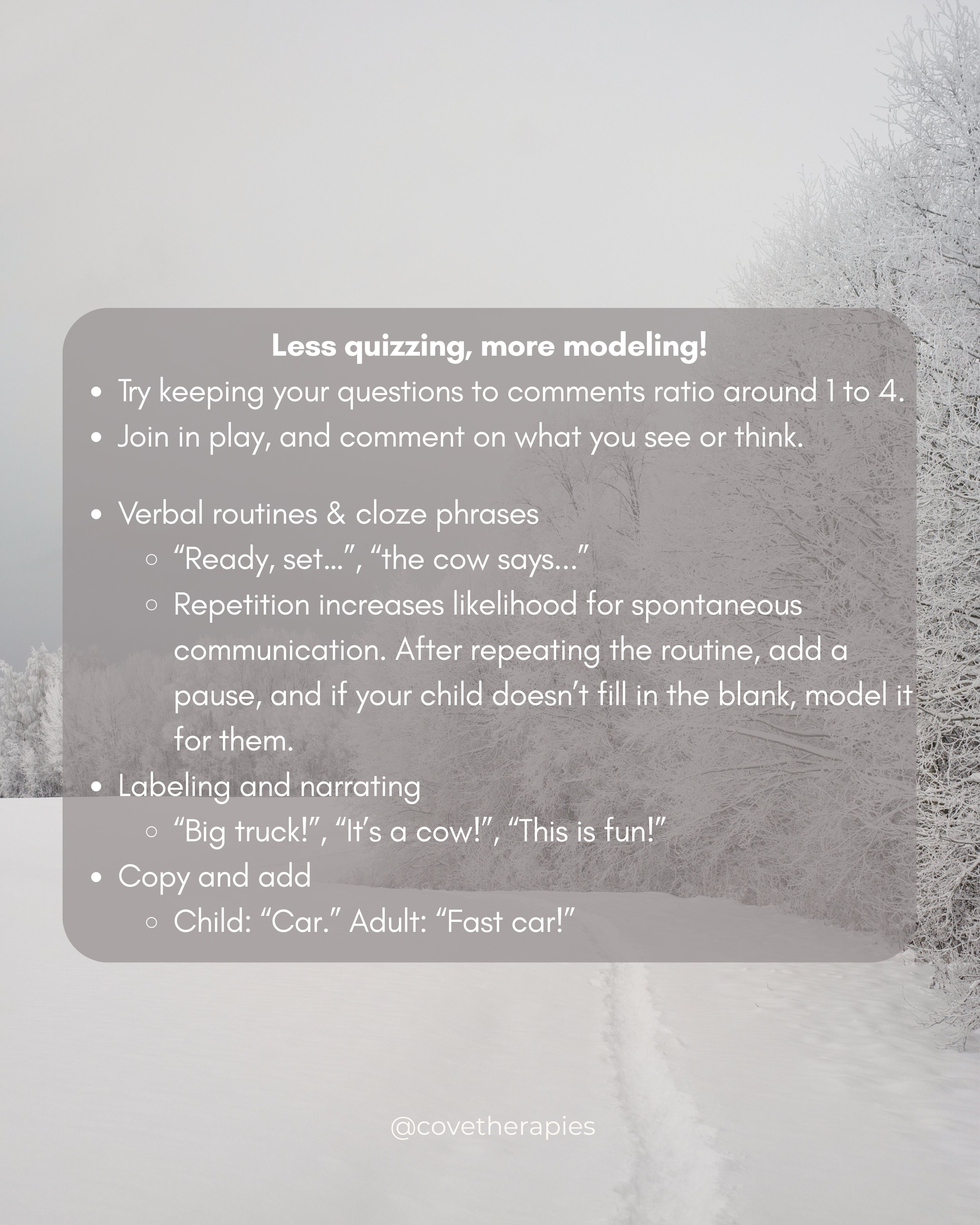
One simple strategy many speech-language pathologists recommend is less quizzing, more modeling. 🧸💬
A helpful guideline is aiming for about 1 question for every 4 comments. 🌱
To support spontaneous communication, try joining your child’s play and commenting on what you see, think, or feel:
Labeling & narrating:
– “Big truck!” 🚗
– “It’s a cow!” 🐮
– “This is fun!” 😊
Copy & add:
– Child: “Car.” Adult: “Fast car!”
Verbal routines & fill-in-the-blank phrases:
– “Ready, set…” 🟢
– “The cow says…” 🐄
Save this tip and give it a try next time you’re playing with your child!

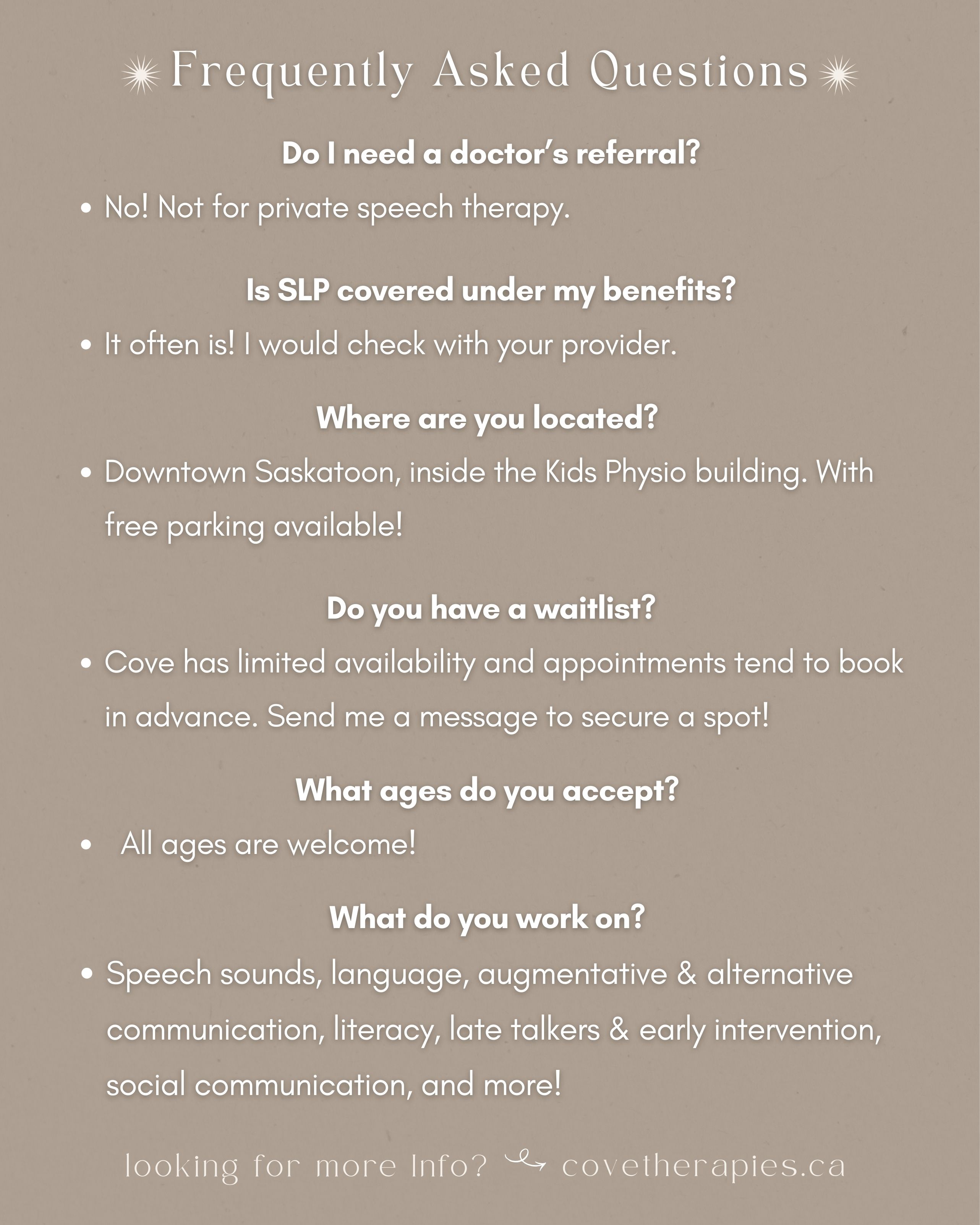
Wondering about seeing a speech-language pathologist? Cove’s speech therapy FAQs — answered ✨
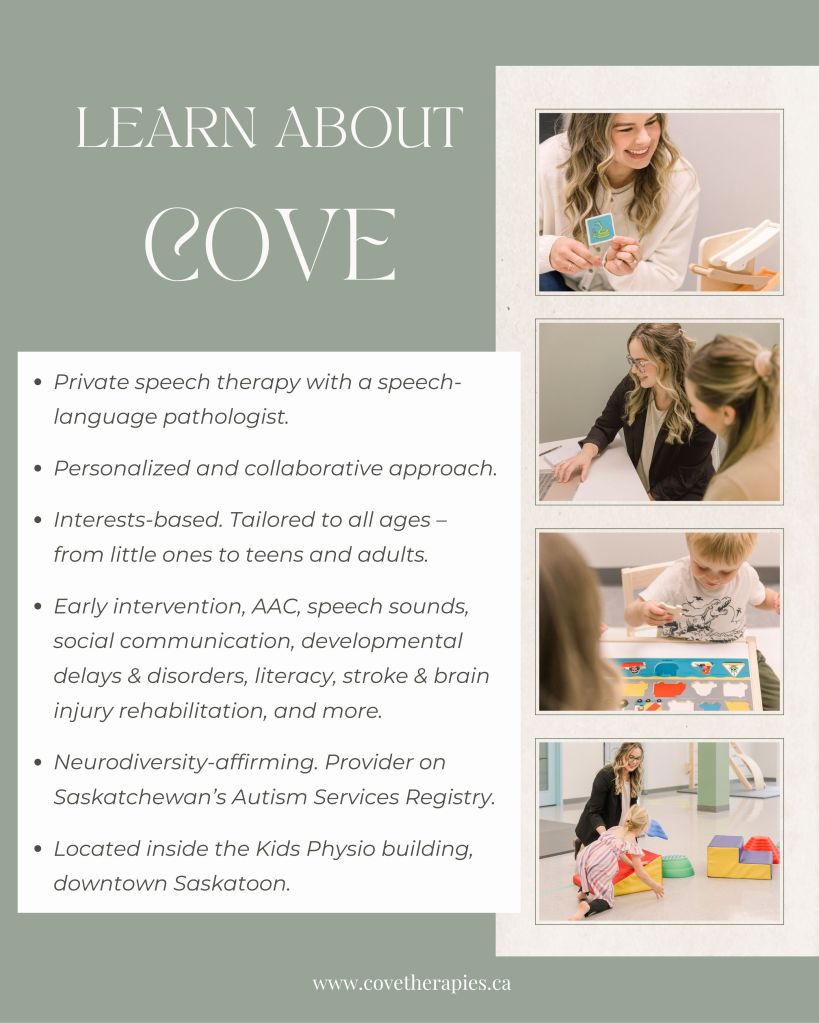
Meet Cove!
As we head into a new year, I wanted to reintroduce Cove — a speech-language pathology practice in Saskatoon offering meaningful, personalized, and collaborative speech therapy with a registered speech-language pathologist (SLP).
At Cove, therapy is tailored to the individual, supporting individuals of all ages, from infants and toddlers to teens and adults. Cove’s approach is strengths-based and practical for real life.
✨ Areas of support include:
• Early intervention
• Language delays & disorders
• Speech sounds
• Social communication
• AAC (Augmentative & Alternative Communication)
• Literacy
• Developmental delays & disorders
• Stroke & acquired brain injury rehabilitation
… and more!
📍 Conveniently located downtown Saskatoon, inside the Kids Physio building.
If you’re searching for a speech therapist in Saskatoon, for pediatric speech therapy or adult speech therapy, or if you have questions about your child’s communication, you’re in the right place!
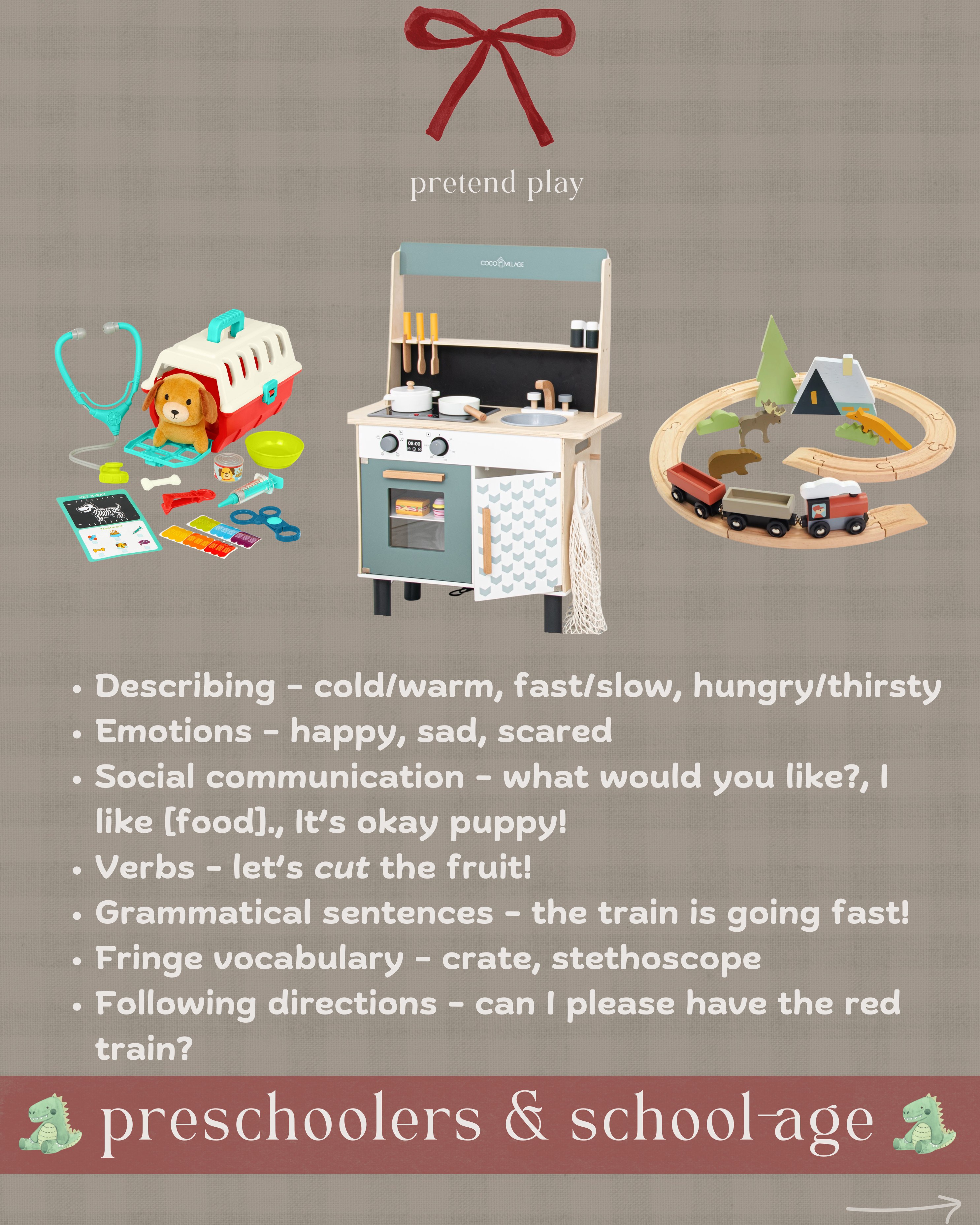
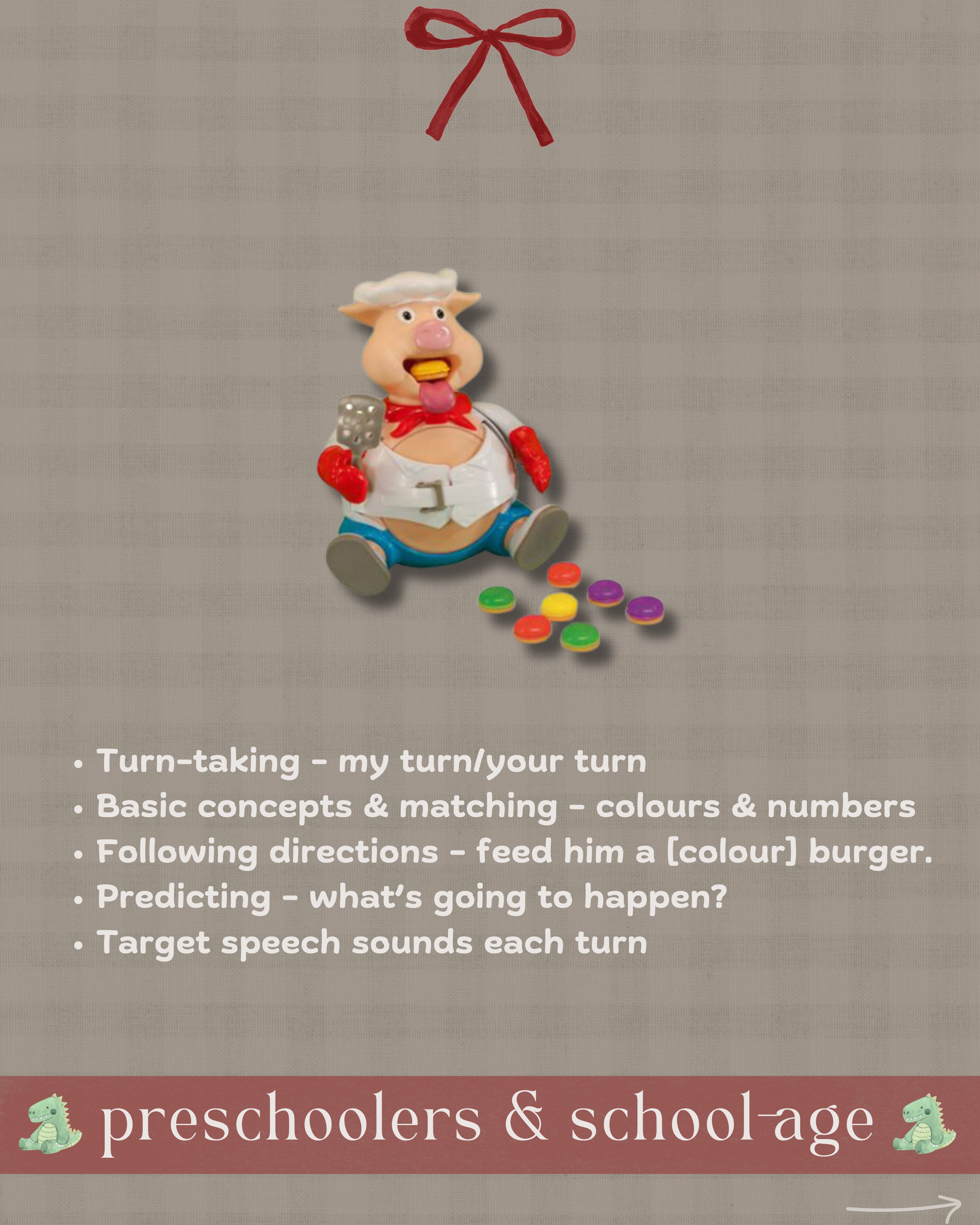
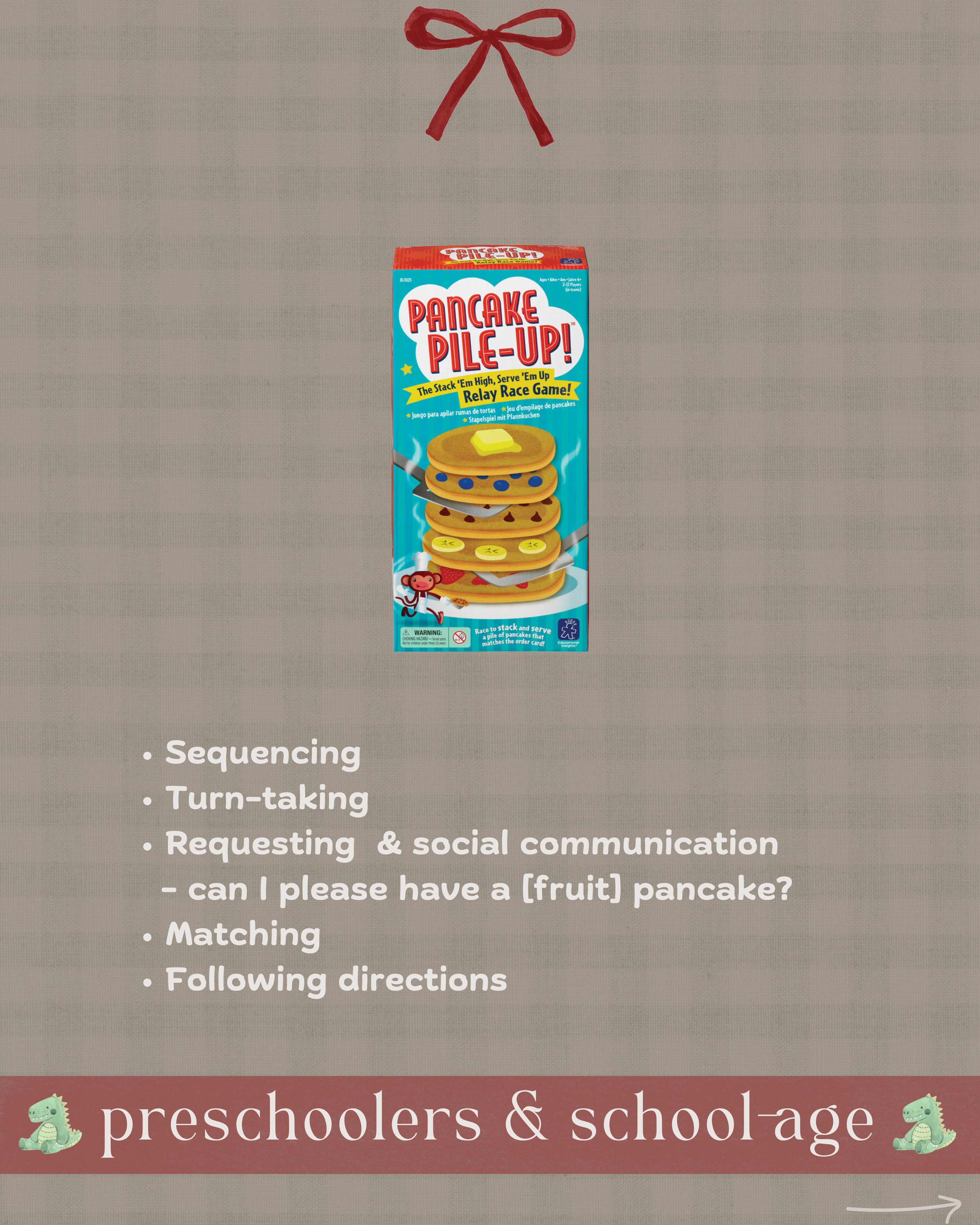
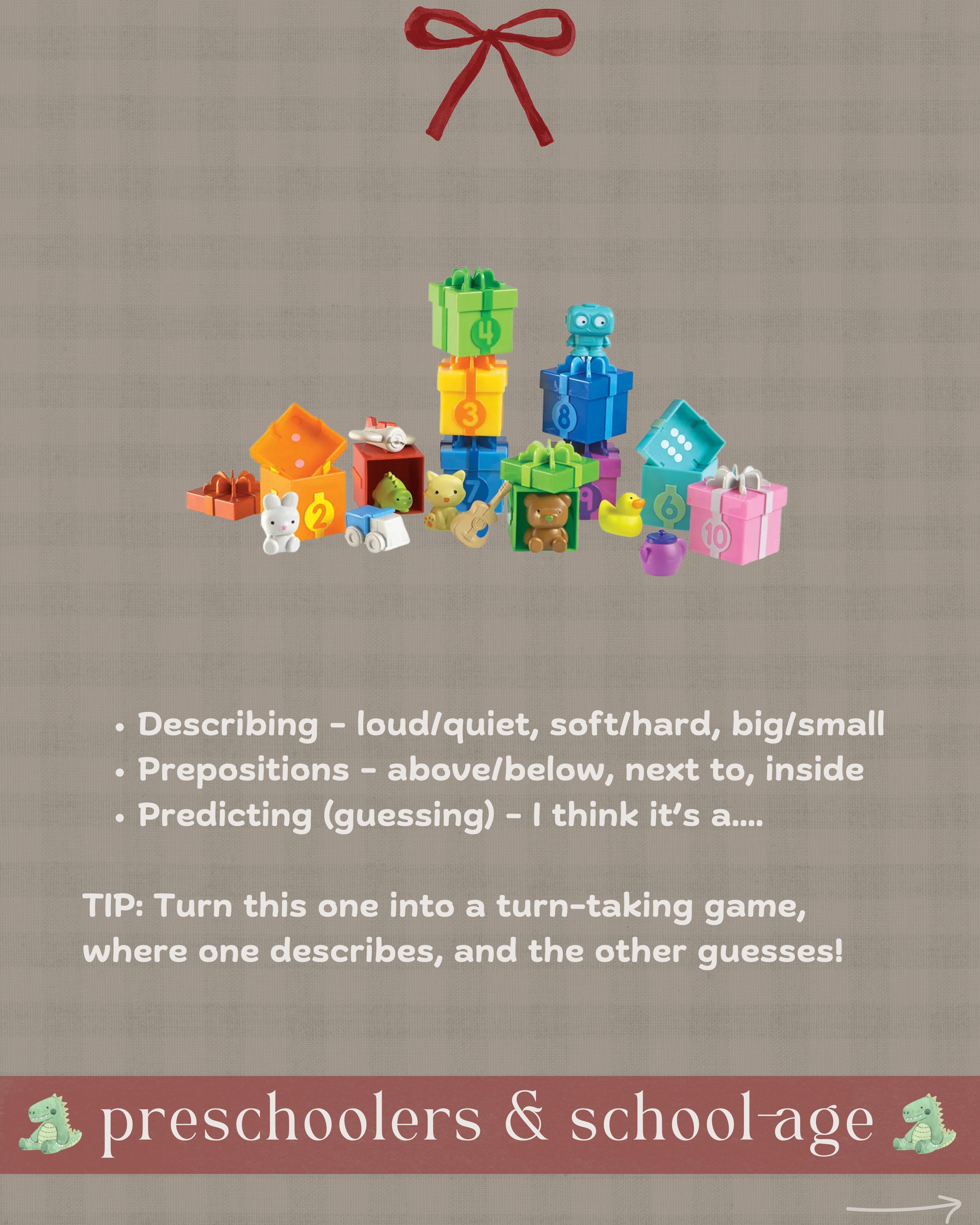
🎄 Preschooler & School-Age Gift Guide: SLP Style 🎄
Part 3/3 of recommending meaningful gifts that can be used to promote communicator skills!
For our growing & older communicators, play becomes richer, more imaginative, and full of opportunities for storytelling, problem-solving, and social skills.
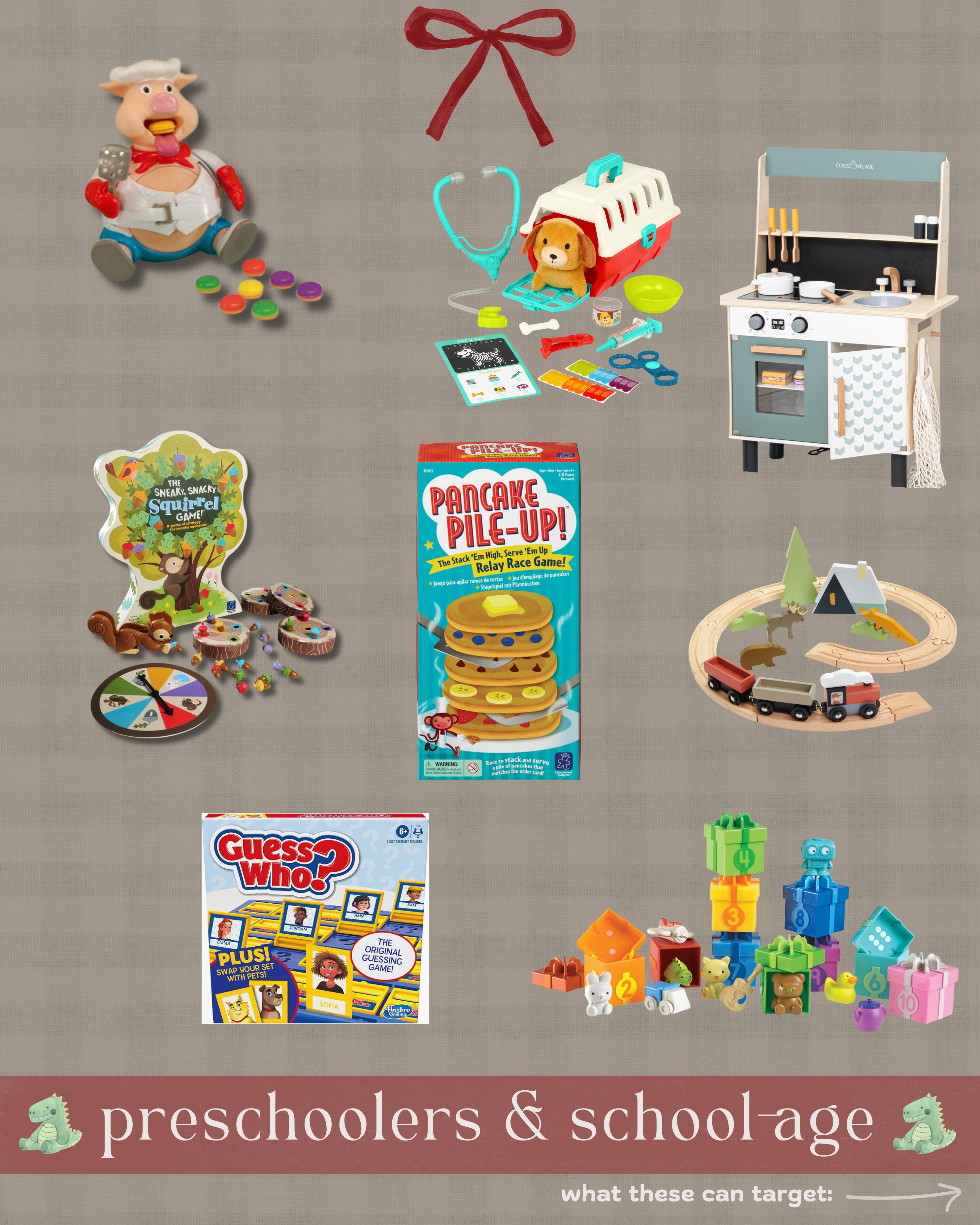
Games & Toys that SLPs use in our own therapy rooms:
1️⃣ Pretend play activities (e.g., vet, kitchen, trains)
2️⃣ Cause & effect games (e.g., Pop the Pig)
3️⃣ Sequencing games (e.g., Pancake Pile-Up)
4️⃣ Learning Resources Surprises Party presents
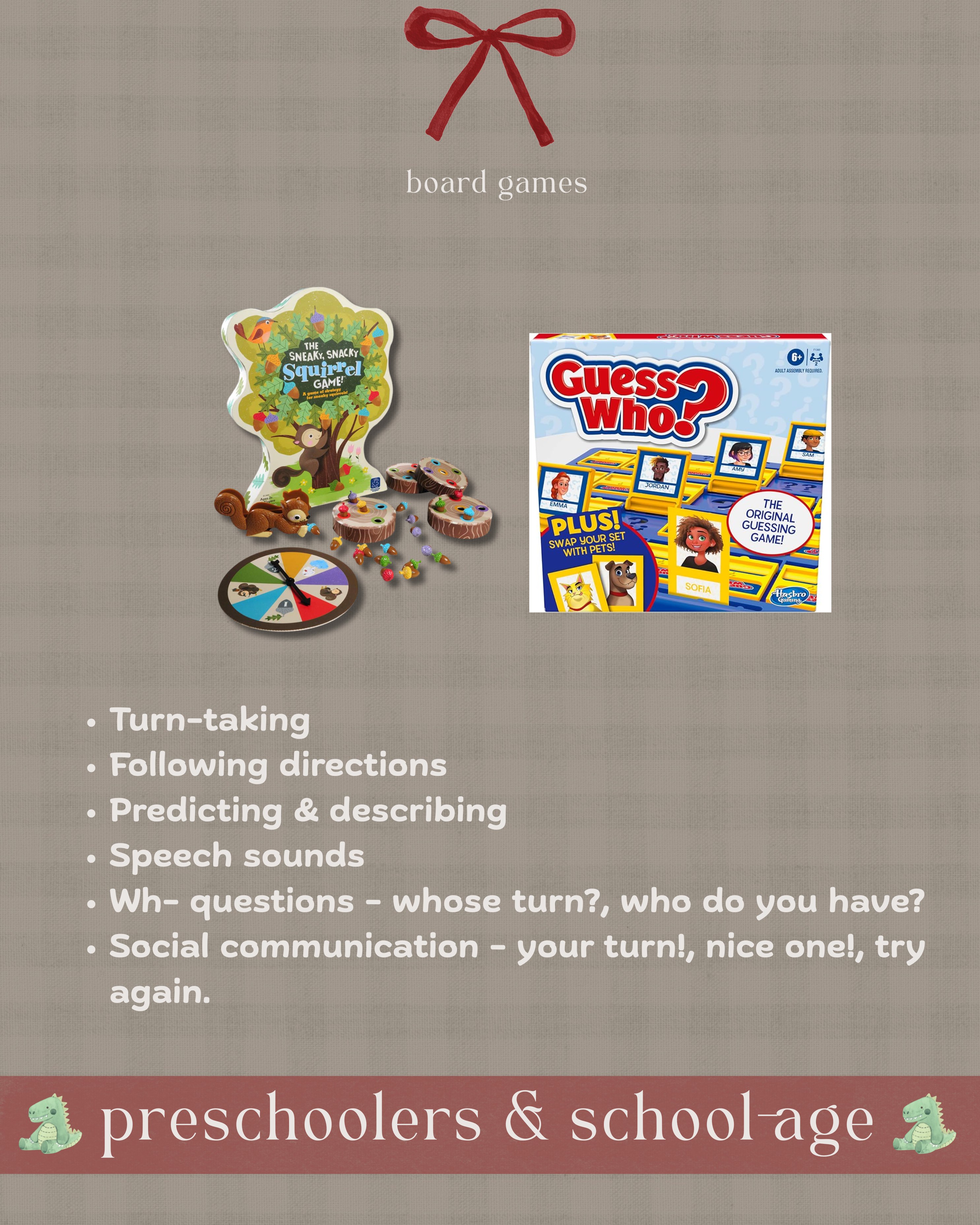
5️⃣ Board games (e.g., Sneaky Snacky Squirrel, Guess Who)
➡️ Swipe for what communication skills toys & games like these can target!
And remember, these games are great, but the biggest impact comes from how you join in. Let your child lead, ask open-ended questions, take turns, and expand on what they say instead of directing or quizzing.✨
Thanks for following! Send me a message if you need any other ideas. 📩
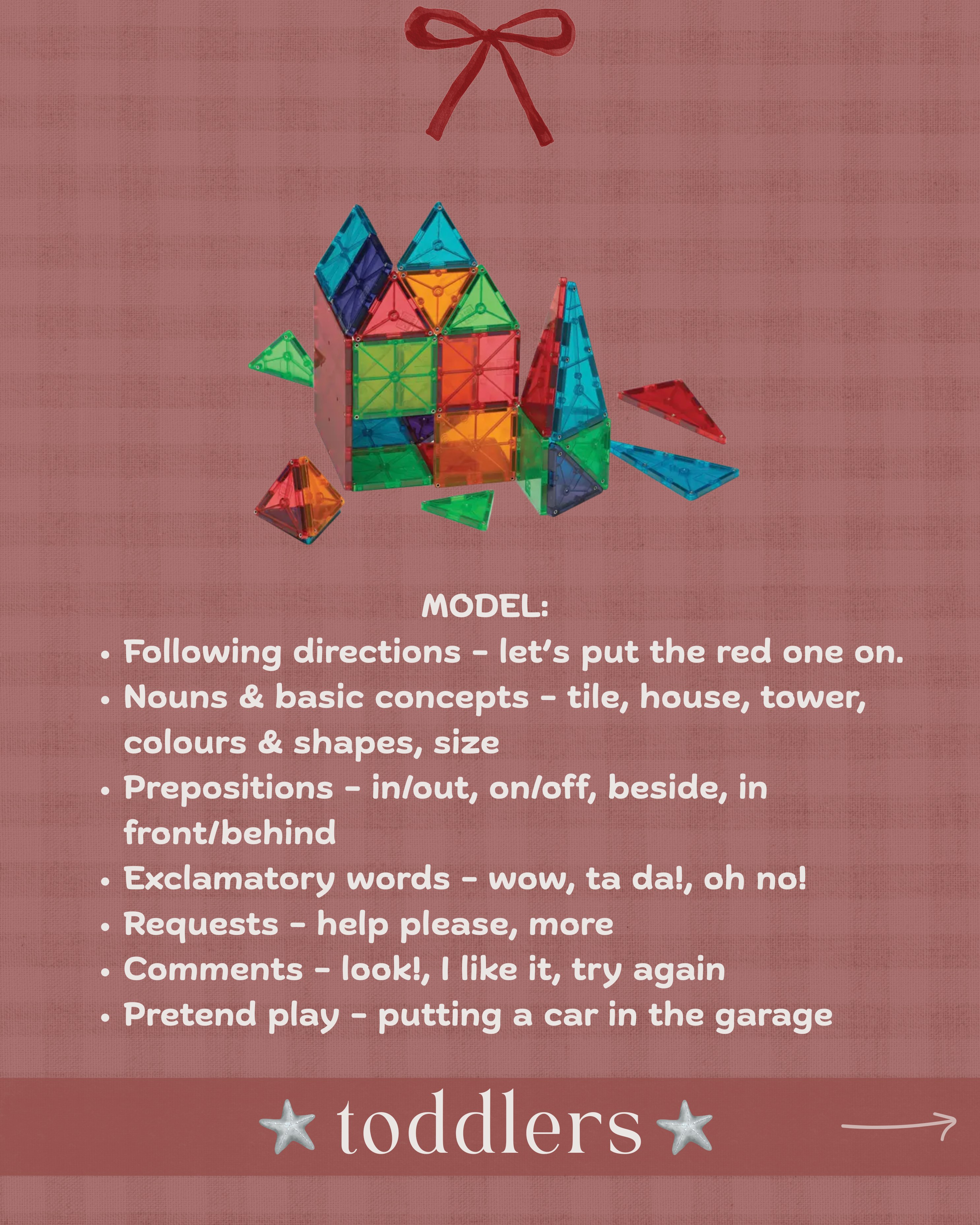
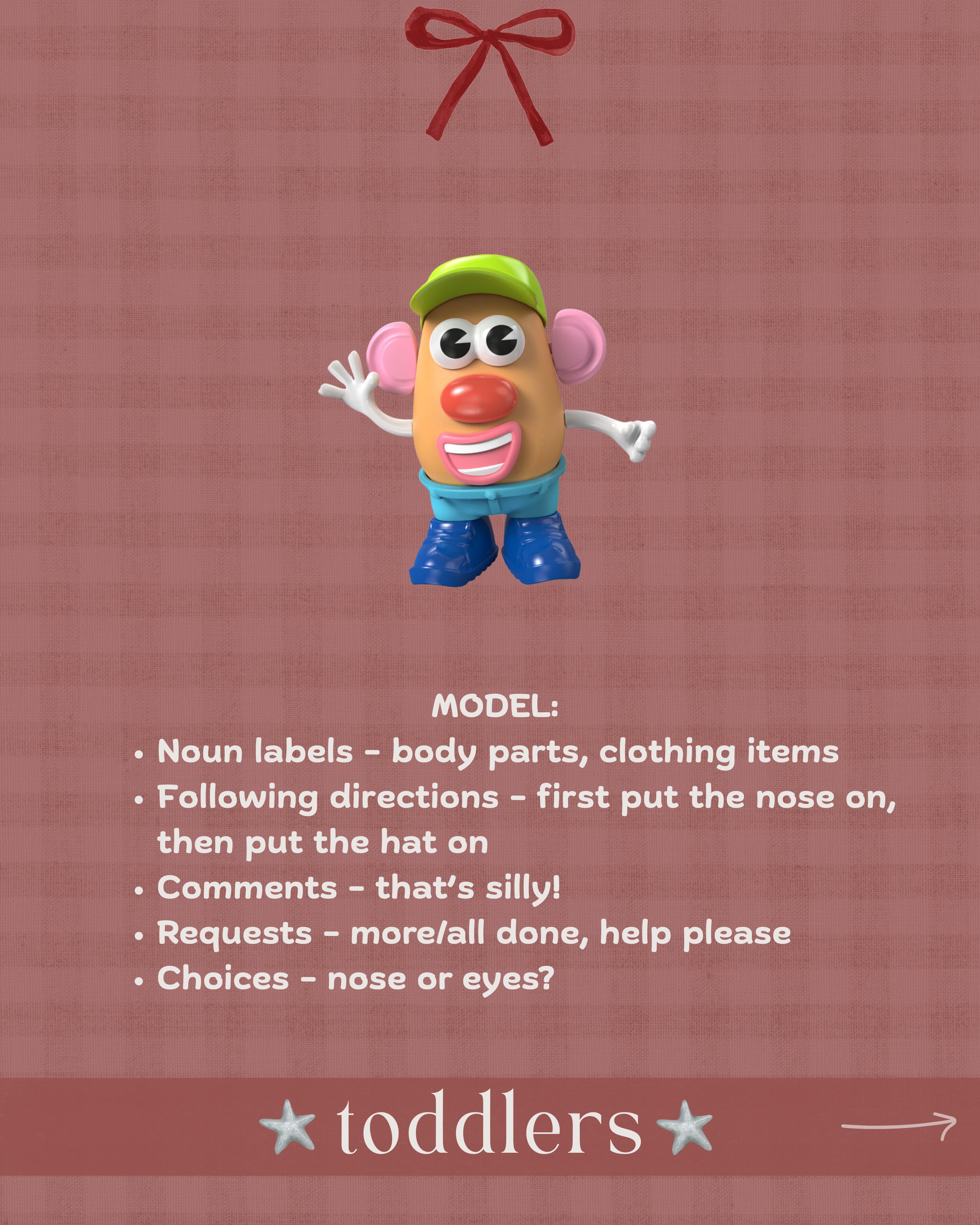
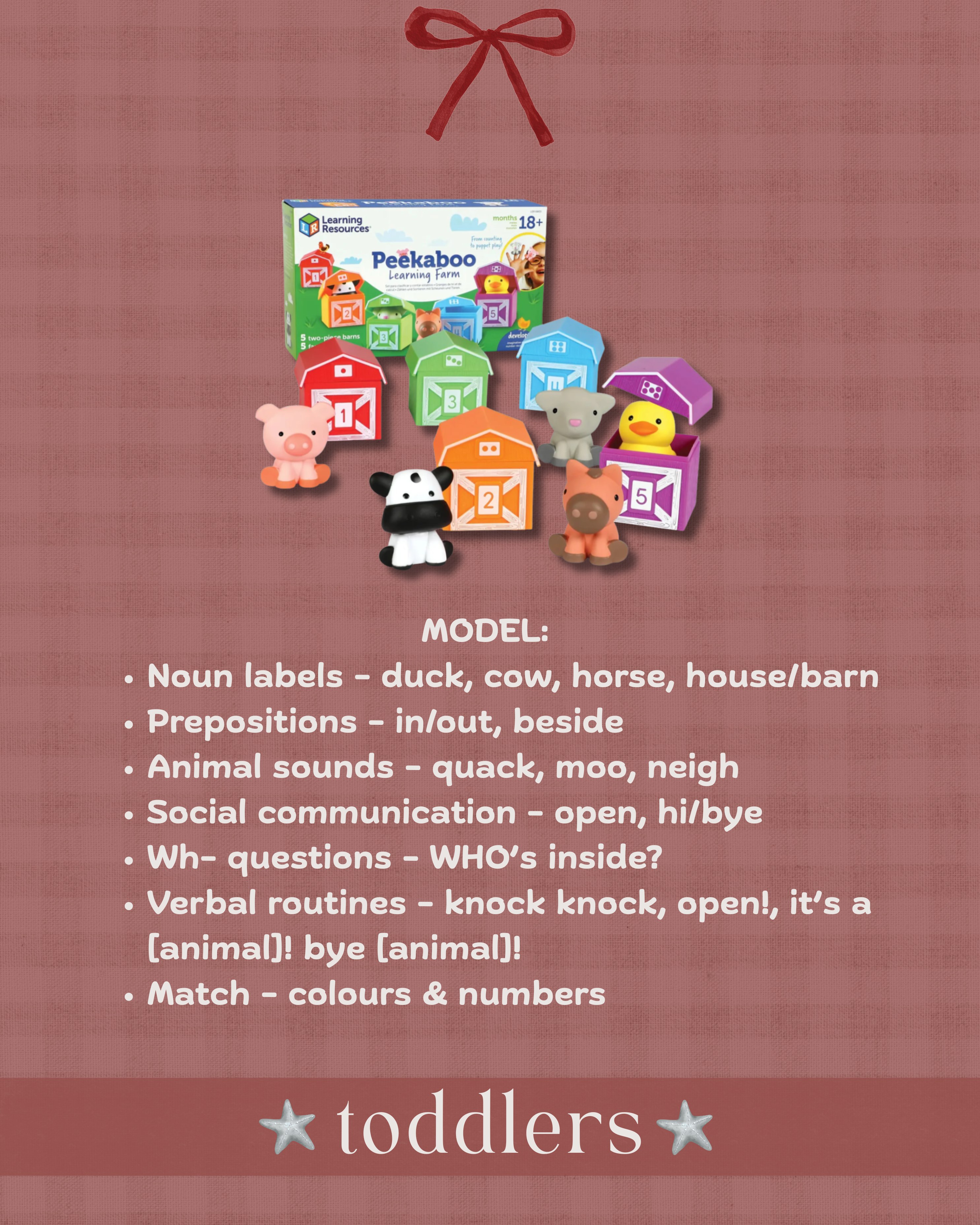
🌟 Toddler Gift Guide: SLP Style 🌟
Part two ✌️of recommending meaningful gifts that can be used to promote communication development!
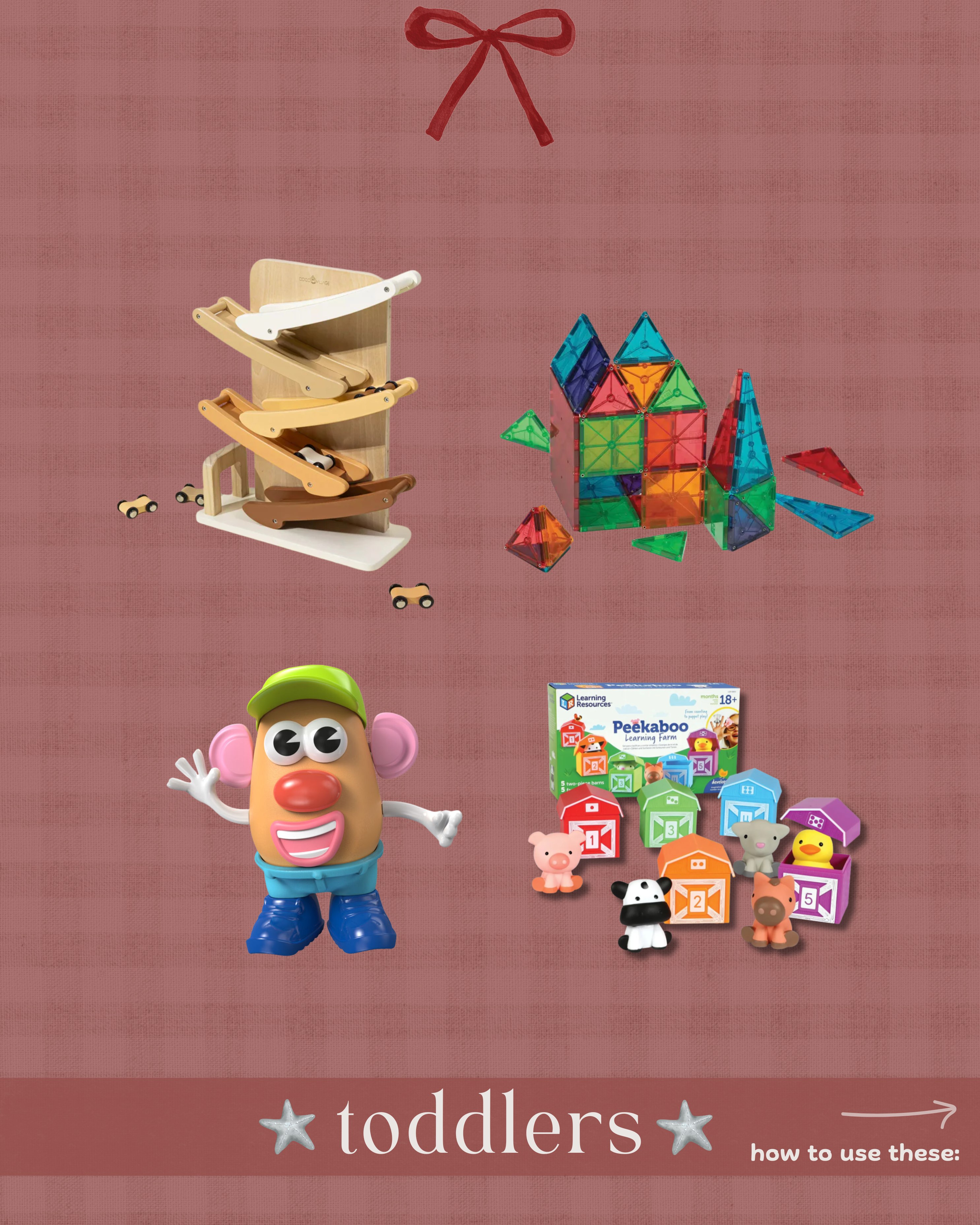
Toddler toys that SLPs use in our own therapy rooms:
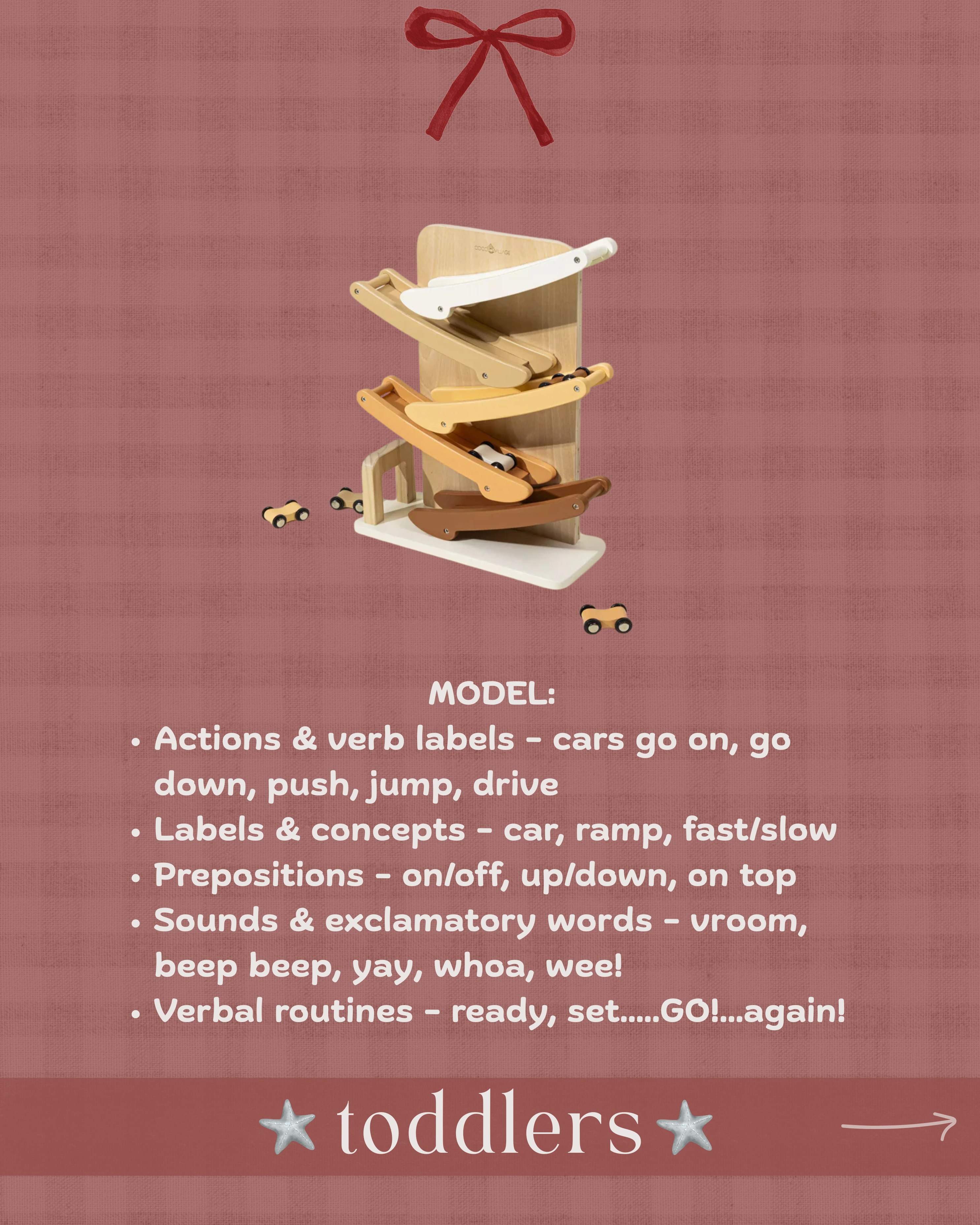
1️⃣ Car ramp
2️⃣ Magnetiles
3️⃣ Mr. Potato Head
4️⃣ Peekaboo learning houses/barns
Remember, these toys are wonderful tools, but the real magic happens when you follow your child’s lead, slow down, and build language into their favourite moments. They learn from your input!
➡️ Swipe for practical ideas to model with these toys or whatever toys your toddler already loves.

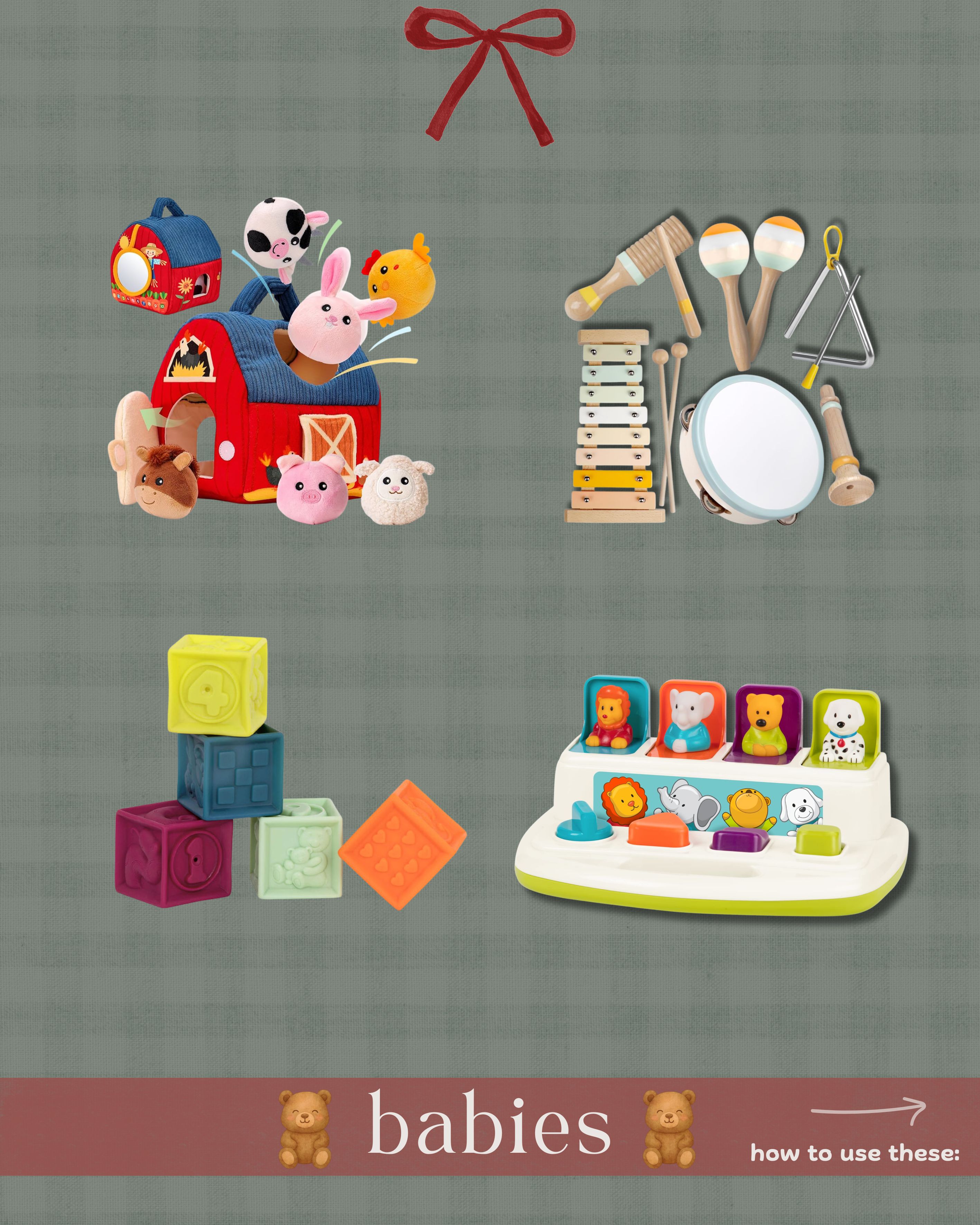
🎁 Baby Gift Guide: SLP Edition 🎁
If you’re looking for meaningful gifts for children that can be used to promote language development, this series is for you!
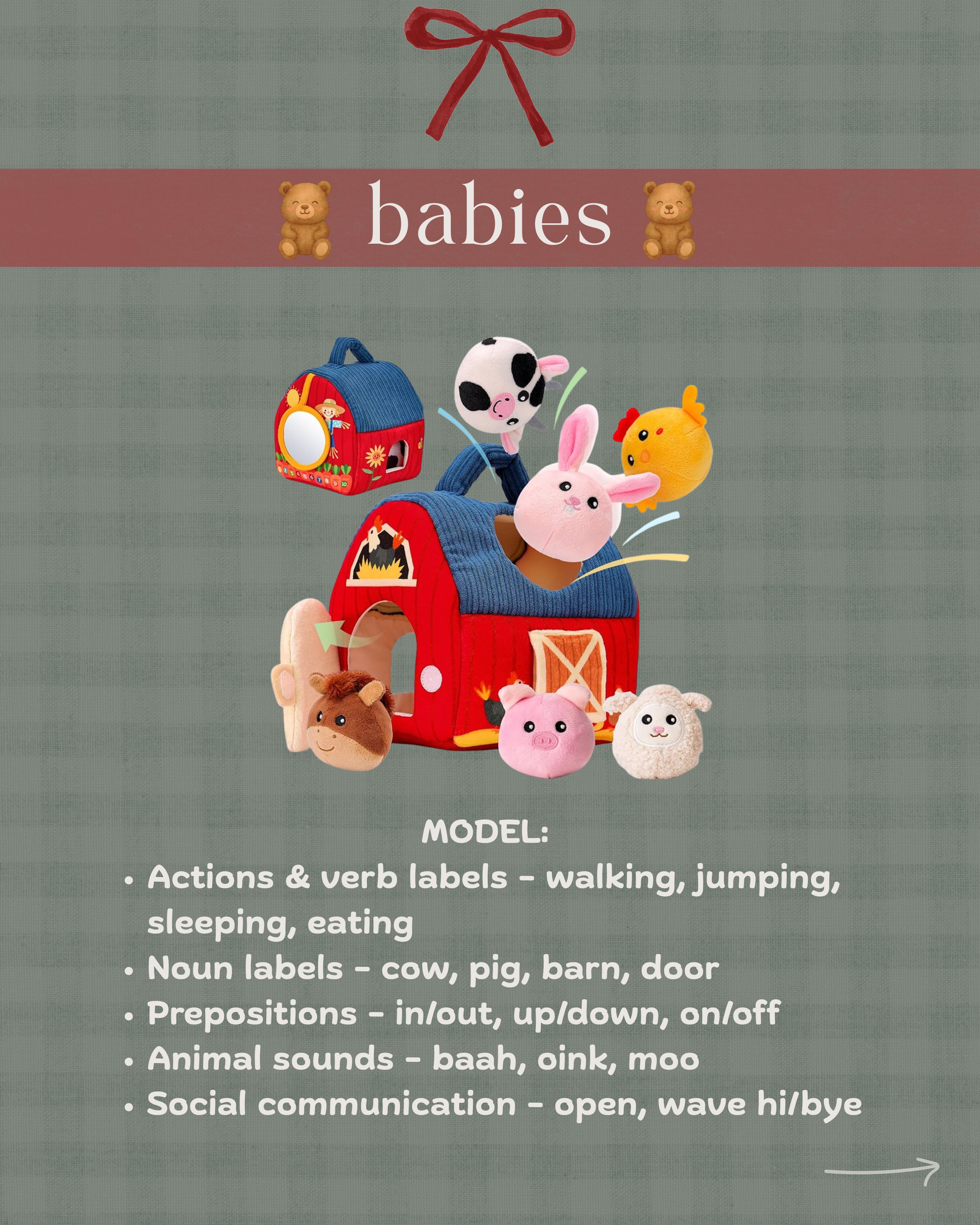
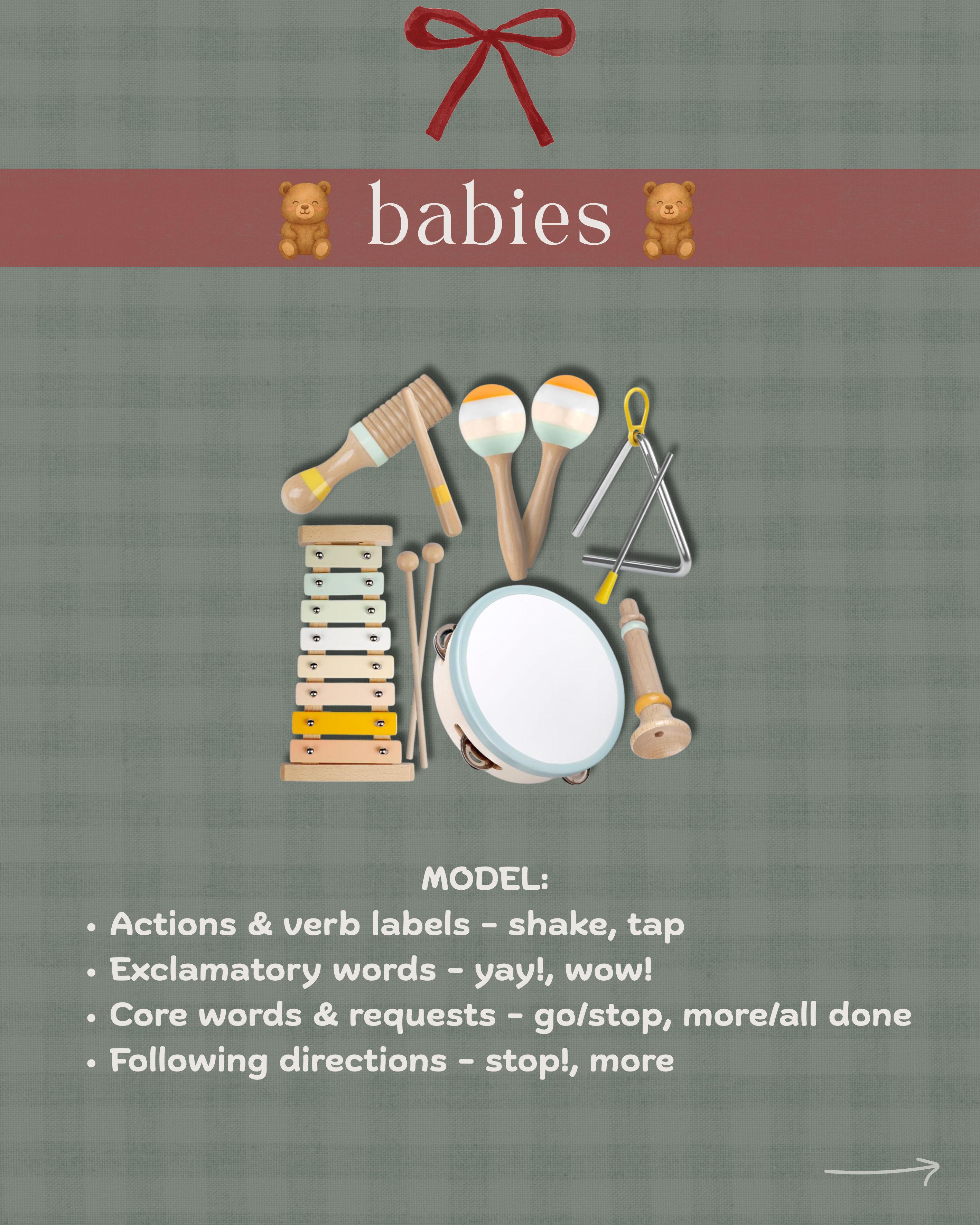
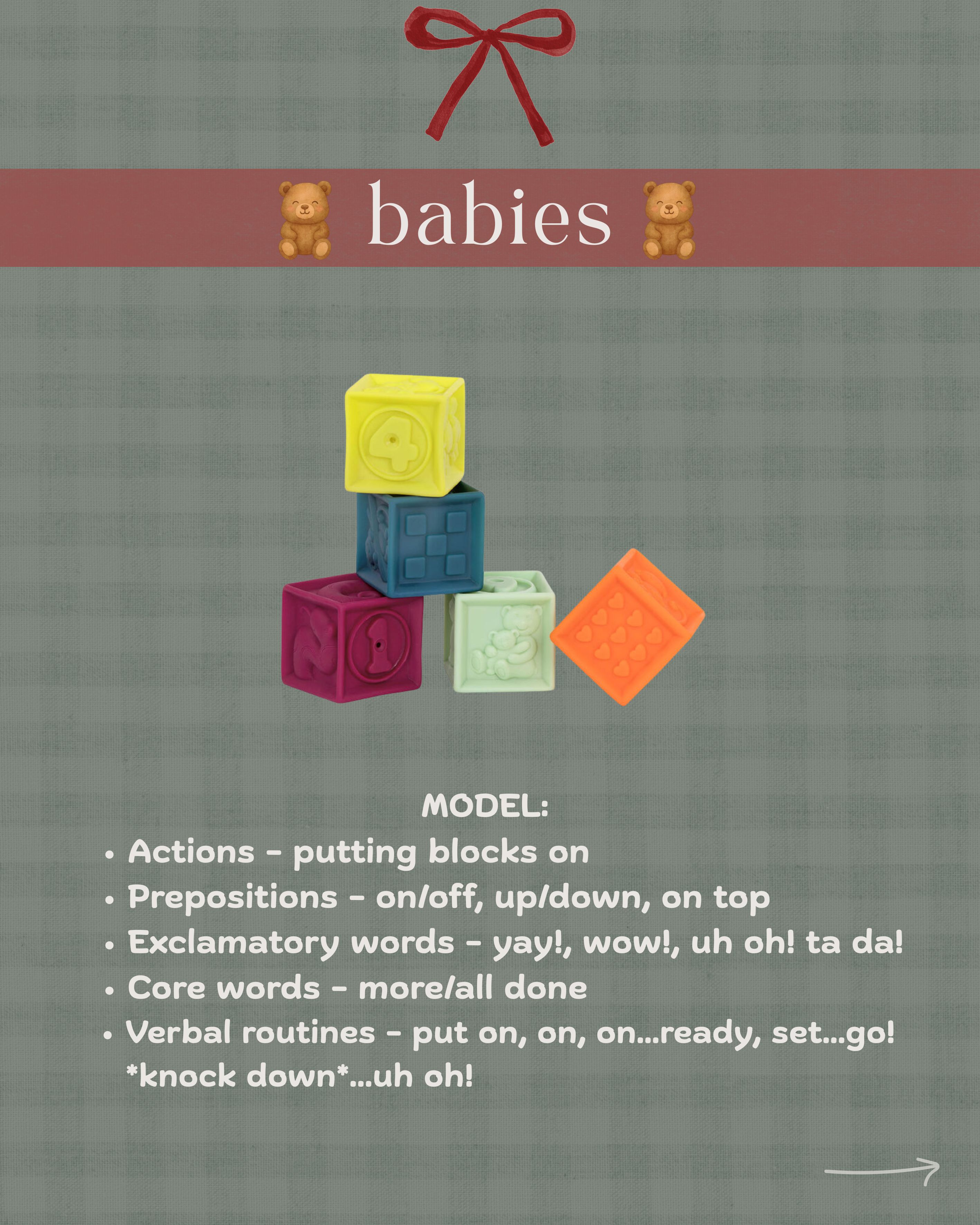
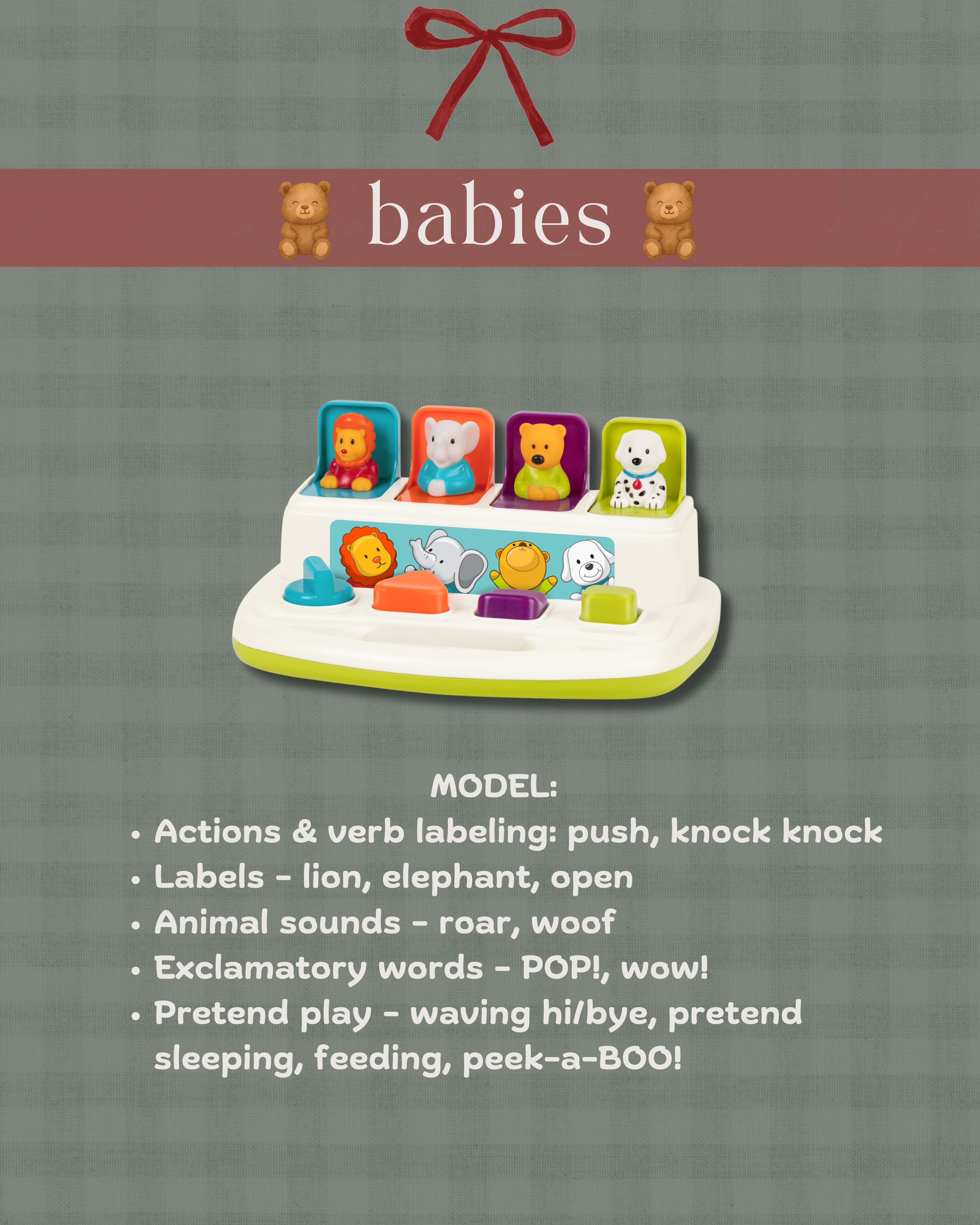
Baby toys (~6-12 mos.) Speech-Pathologists use in our own therapy rooms:
1️⃣ Plush farm animals & barn
2️⃣ Musical instruments
3️⃣ Blocks
4️⃣ Pop-up toy
So often, it’s not about the toy but how you *use* the toy. For our littlest communicators, the best “toys” are the ones that invite connection. Take the opportunity to get on the floor, be face-to-face, model, and enjoy the sweet back-and-forth moments.
➡️ Swipe for simple ways to support early communication using these toys or what you already might have at home!


Caregiver Tip for Late Talkers & Early Communicators: Supporting Imitation
My most recent post was for those wanting to support a little one’s pre-linguistic skills, or those worried about a late talker. Let’s chat more about this!
Imitation & modeling is everything, when it comes to learning to speak and communicate!
💡TIPS:
1️⃣ If your child seems “stuck” in a certain imitation stage, try modeling a bigger variety of skills around that stage.
For example: If they aren’t copying you tapping a drum, model other actions like putting toys in a container or stirring during pretend cooking.
2️⃣ If they aren’t imitating you, try imitating them! Following their lead and copying their actions can boost connection and help imitation grow. 🌱
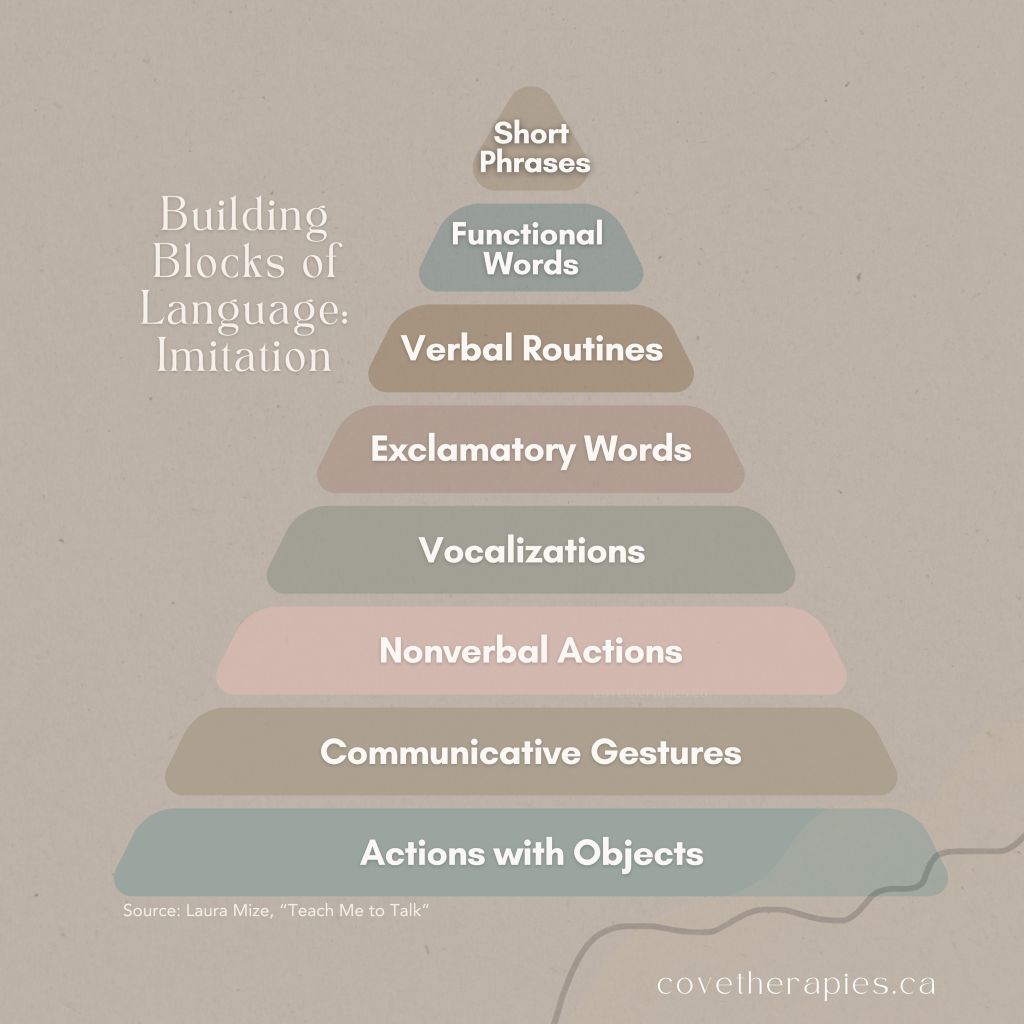
If you’re worried about a late talker or want to support your little one’s early communication skills, this is for you!
Before words come lots of smaller imitation steps. These early skills build the foundation for language, so if a child isn’t copying words yet, they may need support earlier in the sequence.
This visual breaks down 8 “stages” of imitation — all great skills to model with your baby!
1️⃣ Imitates actions with objects: 🧸 Examples: putting a toy in a bucket, pushing a car
2️⃣ Imitates communicative gestures: 👋 Examples: waving, pointing, clapping
3️⃣ Imitates non-verbal actions with face & mouth: 😛 Examples: opening mouth, sticking out tongue
4️⃣ Imitates vocalizations in play: 🔔 Examples: snoring, car/animal sounds, squealing
5️⃣ Imitates exclamatory words: 😲 Examples: uh oh, boo, yay, mmm, wow
6️⃣ Imitates verbal routines: 🎶 Examples: ready-set-go, peek-a-boo, early songs
7️⃣ Imitates functional single words: 📣 Examples: go, all done, mama, ball, more
8️⃣ Imitates short phrases: 🗣️ Examples: my ball, more mama, snack please
✨ Adapted from the imitation hierarchy developed by SLP Laura Mize (teachmetotalk.com).
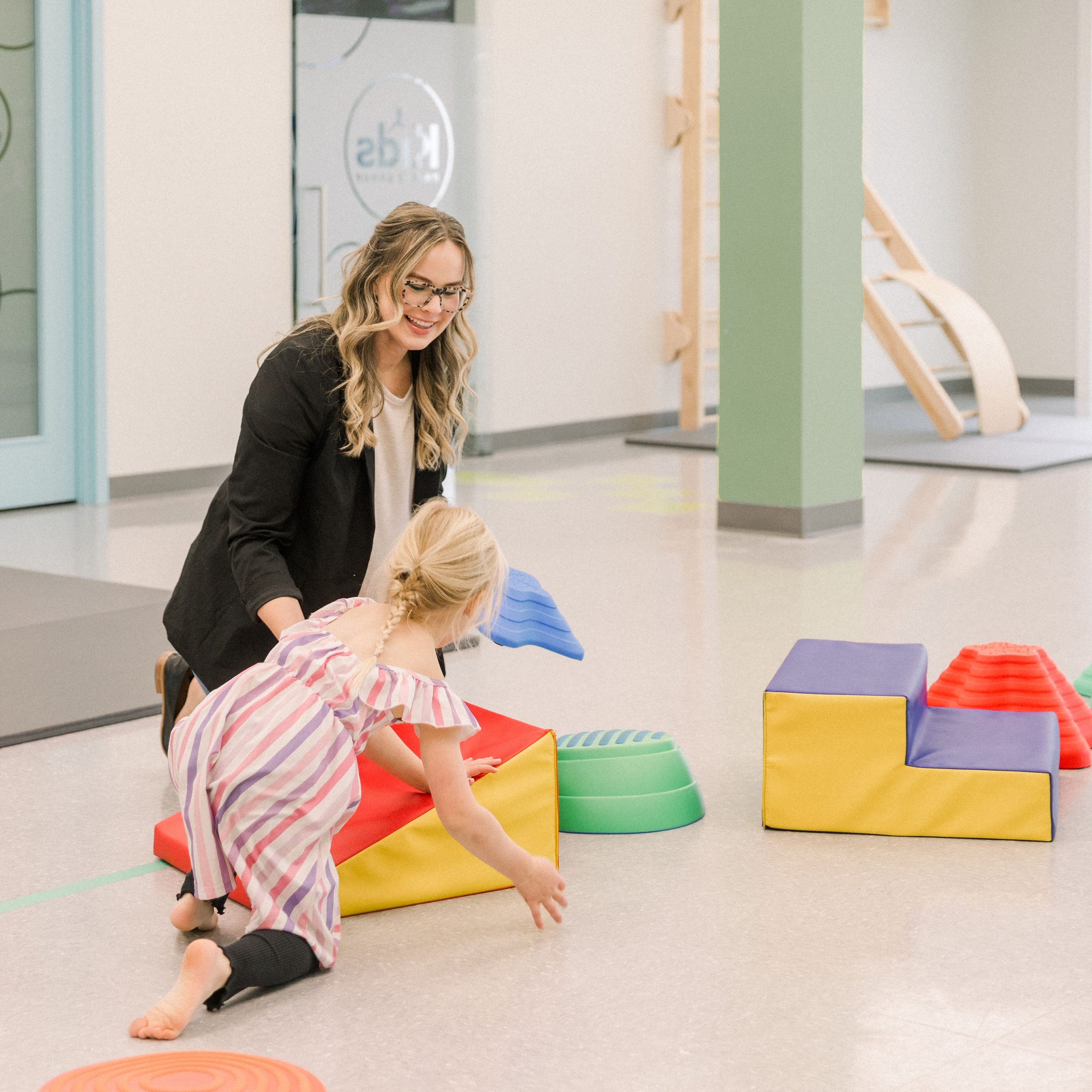
Movement-Based Speech Therapy…
Speech therapy doesn’t always look like sitting at a table. And that’s a good thing!
When kids move, climb, bounce, swing, they’re not “just playing”… they’re building the foundation for many skills, including language. 💬
Supporting sensory needs and gross motor skills during speech therapy sessions can help kids stay regulated, engaged, and ready to communicate! 💛
And thankfully, Cove is located in the best space for this! @saskatoonkidsphysio 🤸♀️

Your Ideas Matter!
Communication isn’t just words – It’s connection and identity. It’s how we share ideas and express who we are! The journey is a privilege to be a part of. ✨
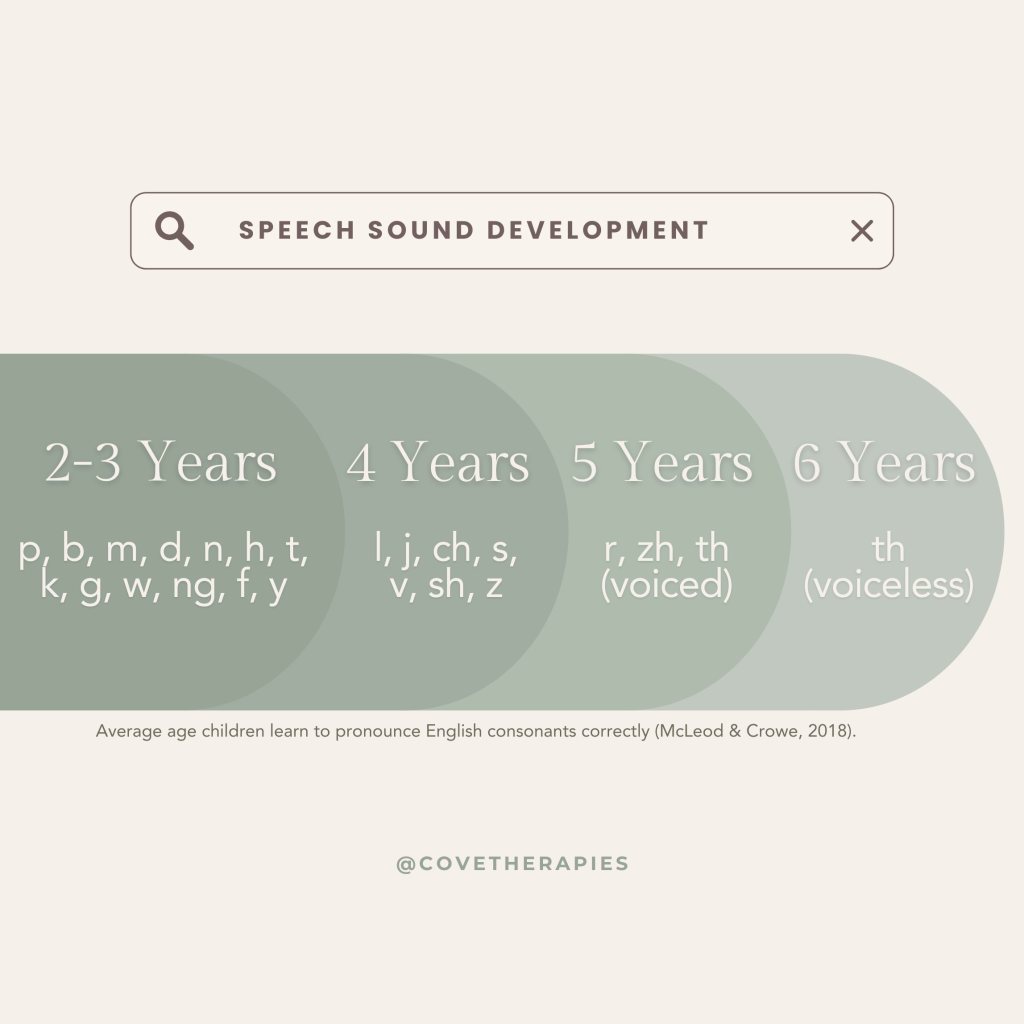
✨ Speech Sound Development ✨
Every child’s speech journey is unique, and that’s expected! Some sounds errors correct themselves naturally, while others may take a bit more time or benefit from extra help.
If you ever have questions or wonder whether your child’s speech is on track, checking in early won’t hurt! Milestone charts can serve as a nice guide, but early support can often benefit children in building clear, confident communication skills. 💬💛
This graphic is shows the average ages children typically learn to pronounce English consonant sounds clearly (McLeod & Crowe, 2018).
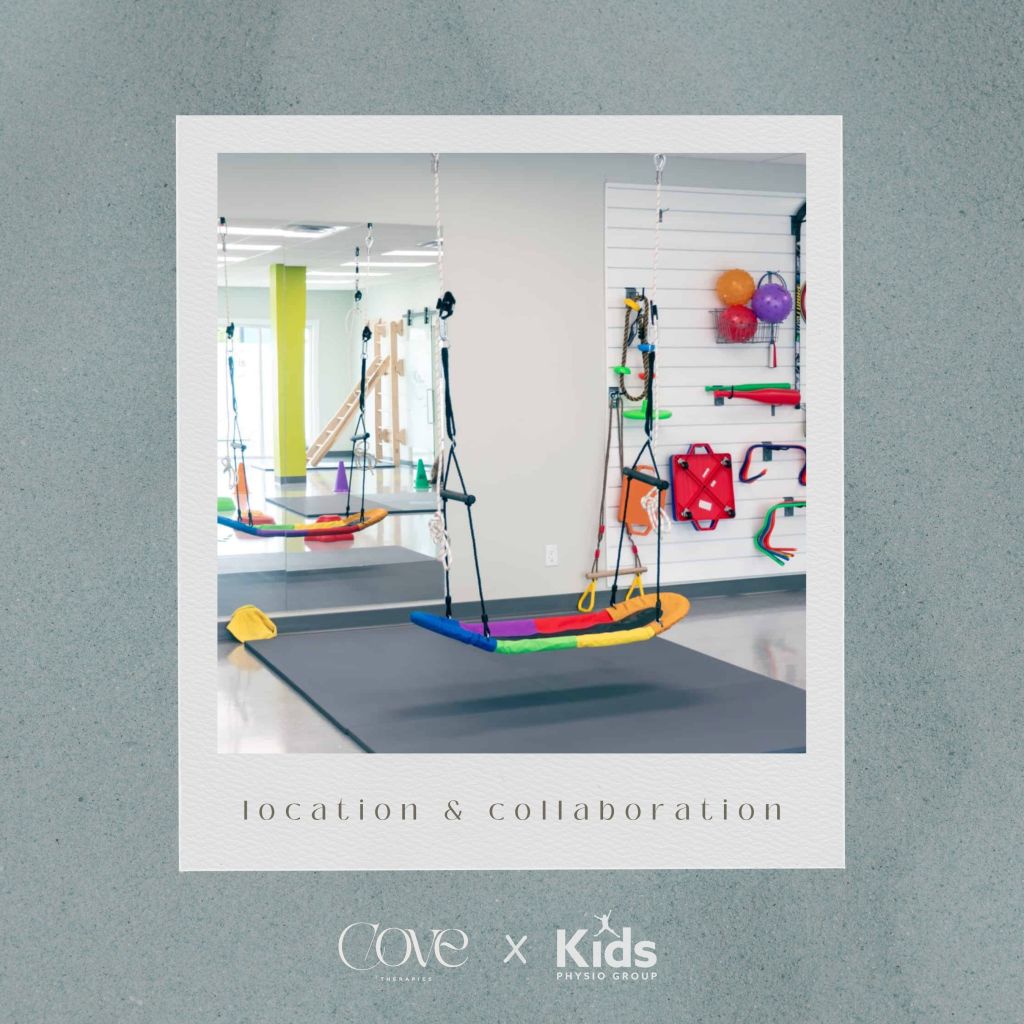
🏡 Location & Collaboration
Cove Therapies found its home inside the Kids Physio building in downtown Saskatoon. Cove is lucky to be a part of such an incredible space, which happens to be full of fun equipment! Being here also opens the door for future collaboration and using a well-rounded approach to supporting families. 🌟
Looking for speech therapy in Saskatoon? Check out our spot!
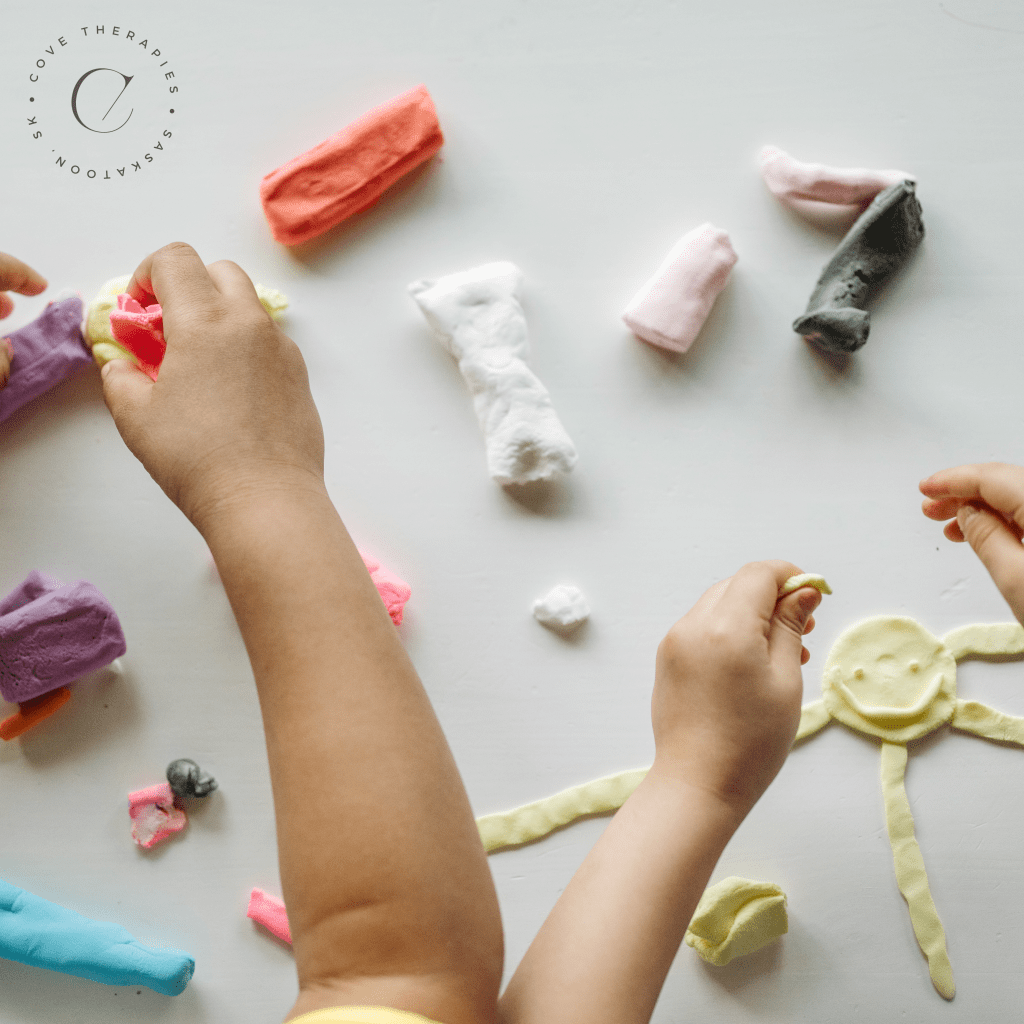
Play-based speech therapy!💡 Did you know…
Play-based speech therapy isn’t just fun — it’s evidence-based! Research suggests that play creates the perfect setting to help kids connect, learn, and grow their communication skills. It also helps them develop social skills, problem-solving skills, confidence, and more. Play IS learning!
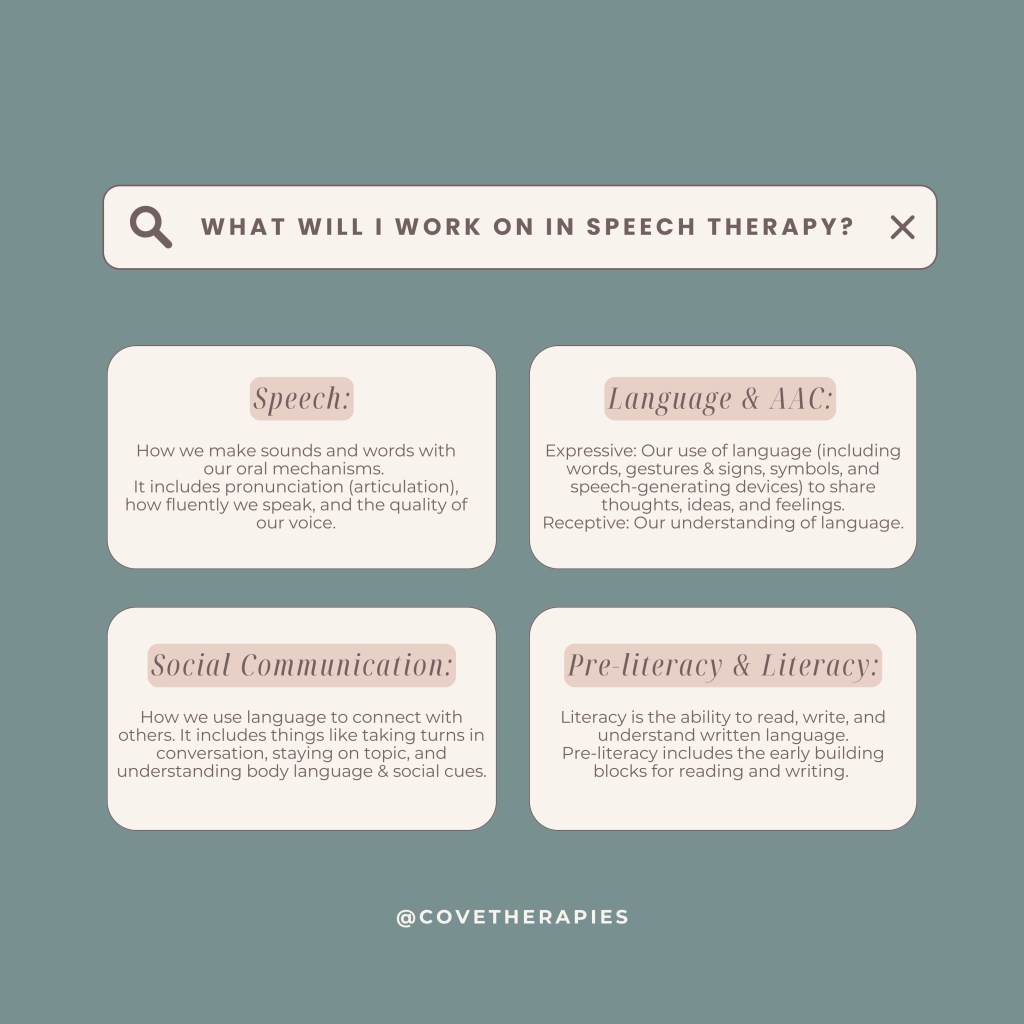
Domains of Speech & Language
Wondering what your SLP can work on with you or your loved one in speech therapy?
Believe it or not, it’s a lot more than speech!
Here’s just a taste. ✨
Communication is colourful! 🌈
Because it doesn’t look the same for everyone. It might be spoken words, signs, gestures, pictures, or devices. Every individual expresses themselves and connects in their own unique way — and that diversity is something to celebrate.

Cove Therapies
covetherapies@gmail.com
380 C 2nd Ave N, Saskatoon, SK
 Cove Therapies